A small fishing kayak does not need a huge chartplotter or a heavy battery. For most paddlers, the better setup is a compact fish finder that is easy to read, draws little power, and can be installed without turning the deck into a drilling project.
The Garmin Striker 4 is our best overall low-power fish finder for a small kayak. It combines a compact 3.5-inch screen, traditional CHIRP sonar, GPS waypoint marking, and a published typical current draw of only 0.23 amps. Anglers who want clearer structure detail should consider the Garmin Striker Vivid 4cv, while renters and inflatable-kayak owners may be better served by a castable unit such as the Garmin Striker Cast GPS or Deeper PRO+ 2.
This guide compares six practical options using published specifications, power requirements, mounting choices, kayak-specific limitations, and recurring feedback in customer reviews. We have not presented these units as personally field-tested. Prices and availability change, so confirm both before buying.
Disclosure: Some links below are Amazon affiliate links. If you buy through one, Angler Beacon may earn a commission at no extra cost to you.
Quick picks
| Fish finder | Best for | Published power or battery figure | GPS or mapping | Installation |
|---|---|---|---|---|
| Garmin Striker 4 | Best overall for a small kayak | 0.23A typical draw | GPS waypoints | In-hull, scupper, or track arm |
| Humminbird PiranhaMAX 4 | Lowest published current draw | 0.18A | No GPS | External or compatible kayak mount |
| Garmin Striker Vivid 4cv | Best compact imaging upgrade | 0.40A typical draw | GPS and Quickdraw Contours | External mount preferred for ClearVü |
| Lowrance Eagle 4x | Best simple screen in bright conditions | Check current manual for exact configuration | No mapping on 4x | Track arm or compatible mount |
| Garmin Striker Cast GPS | Best for rental kayaks | 10 hours typical internal battery life | GPS and Quickdraw Contours | No permanent installation |
| Deeper PRO+ 2 | Best castable sonar for detailed mapping | Up to 9 hours | Built-in GPS mapping | Cast, tow slowly, or use removable arm |
How we selected these fish finders
Kayak electronics should be judged differently from electronics for a bass boat. A small kayak has less deck space, less battery capacity, more exposure to spray, and fewer places to hide cables. We prioritized:
- compact screens or self-contained castable designs;
- low published current draw or useful internal battery life;
- controls that remain practical with wet hands;
- GPS, mapping, or sonar features that justify the space they occupy;
- removable, in-hull, scupper, and no-drill mounting options;
- clear limitations, including missing GPS, phone dependence, and imaging restrictions.
We used manufacturer specifications where available, then checked retailer reviews and owner discussions for recurring praise and complaints. A single review can reflect a defective unit, incorrect installation, or user error, so we treat repeated themes as more useful than isolated claims. Runtime calculations later in the article are planning estimates, not laboratory guarantees. Review counts and ratings below were recorded during research in August 2026 and may change as retailers add or remove reviews.
1. Garmin Striker 4 — Best overall low-power fish finder for a small kayak
The Garmin Striker 4 remains a strong fit for anglers who want a dedicated screen without carrying a large electronics battery. Garmin lists a 3.5-inch color display, traditional CHIRP sonar, a dual-beam transducer, high-sensitivity GPS, and a typical current draw of 0.23 amps at 12 volts.
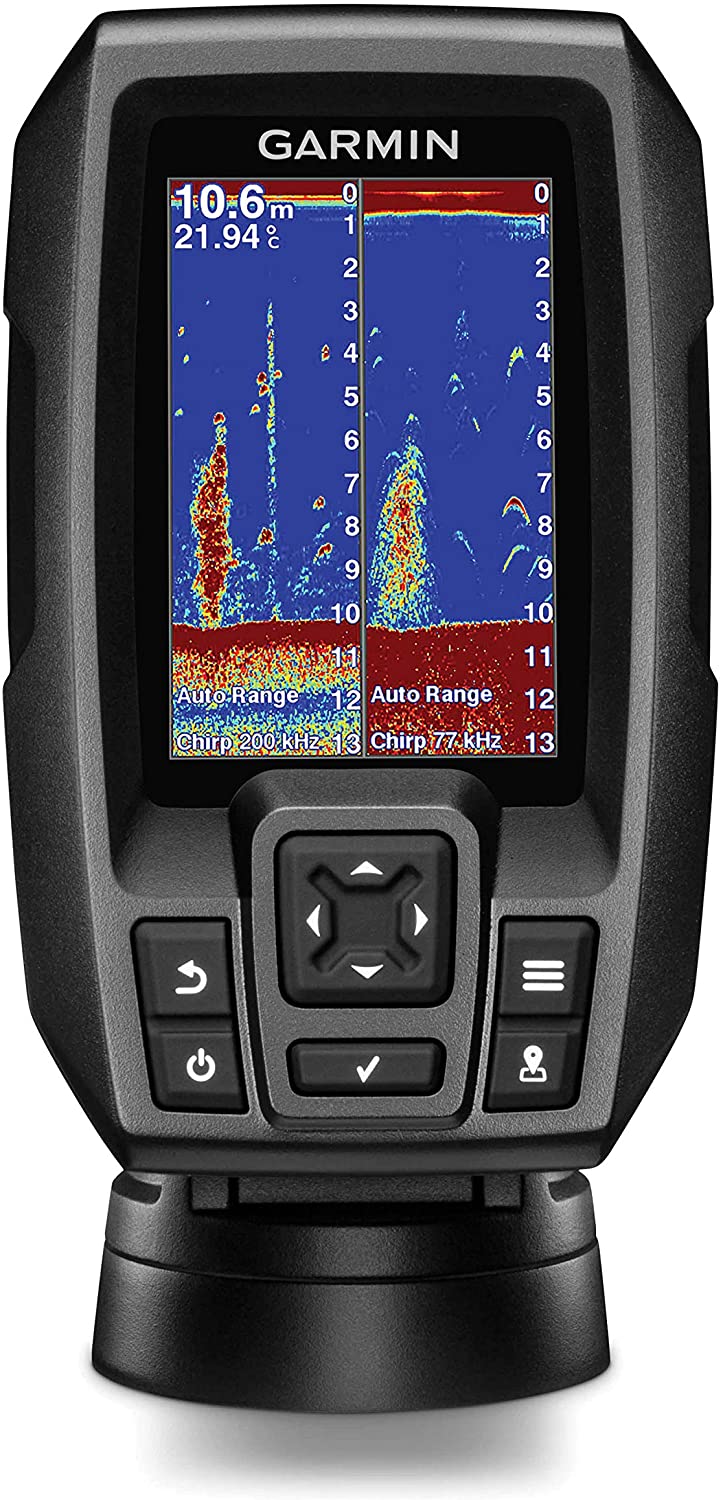
That last specification is the main reason it works so well on a kayak. A small 12-volt battery can support a full fishing day with a substantial reserve, while the keyed controls avoid the wet-screen problems that can make touch displays frustrating on paddle craft.
The built-in GPS can save waypoints such as launch ramps, brush piles, drop-offs, and productive ledges. However, buyers should understand that the basic Striker 4 is not a full chartplotter and does not provide the ClearVü imaging found on the Striker Vivid 4cv.
What customer reviews say
The broad owner response is positive but not flawless. At the time of research, Canadian Tire showed a 4.4 average from 61 reviews. Buyers repeatedly praise the value, depth readings, portability, and long service life. Complaints most often concern the small screen, limited chart detail, mounting hardware, cables, and difficulty interpreting fish returns. Several owners describe it as better at showing depth and bottom changes than providing an effortless “fish on screen” answer. That is a limitation of both entry-level sonar and user interpretation, not proof that every return is inaccurate.
Customer-review reference: Canadian Tire Garmin Striker 4 reviews
Why it suits a small kayak
- compact 3.5-inch display;
- published typical draw of 0.23A;
- GPS waypoint marking;
- physical buttons;
- compatible with removable and in-hull installation approaches;
- traditional CHIRP without the power and mounting demands of live sonar.
Limitations
- the screen can feel small when mounted far from the seat;
- no ClearVü or SideVü on the basic model;
- mounting the supplied transducer still requires planning;
- the standard package is not a completely self-contained portable kit.
Who should buy it
Choose the Striker 4 if you own a small sit-on-top or polyethylene fishing kayak and want dependable depth, traditional sonar, and GPS waypoints with minimal power demand. It is also the easiest unit in this guide around which to build a compact battery box.
Manufacturer information: Garmin Striker 4
2. Humminbird PiranhaMAX 4 — Best for minimum current draw
The Humminbird PiranhaMAX 4 is worth considering when battery efficiency matters more than GPS. Humminbird publishes a 180 mA power draw, or 0.18 amps, along with a 4.3-inch color display and dual-beam sonar at 200 and 455 kHz.
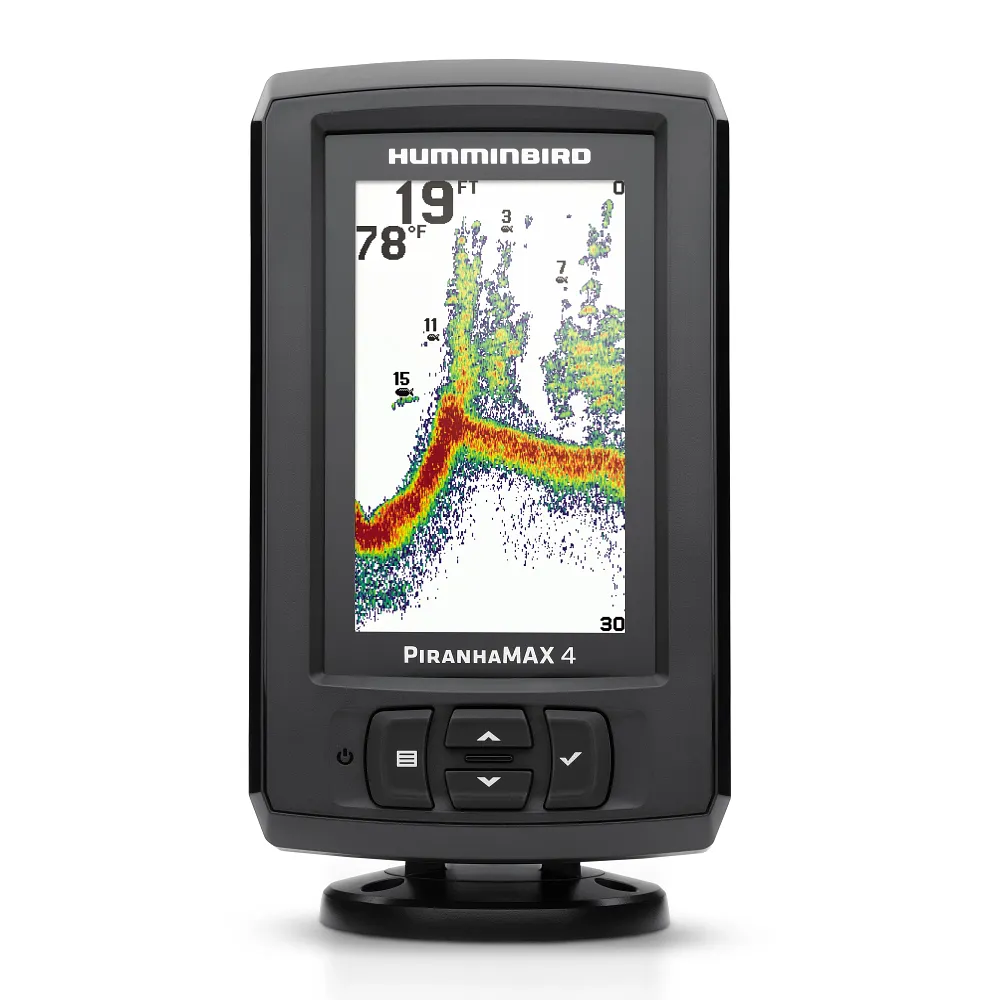
Its larger screen is easier to view than the Garmin Striker 4 display, yet the published current draw is even lower. The tradeoff is straightforward: the PiranhaMAX 4 does not provide GPS, charting, track plotting, or a memory-card slot. It is a fish finder rather than a navigation tool.
What customer reviews say
Retailer feedback is mixed by package and seller. Walmart's standard PiranhaMAX 4 listing showed 4.4 from 98 ratings during research, while another retailer listing showed a lower score for the portable-kit version. Positive comments focus on the clear 4.3-inch display, simple depth information, and low price. The recurring negative themes are the absence of GPS, installation or transducer-mount frustration, and expectations that exceed what a basic dual-beam unit can display. Check the exact model number because the standard, DI, and portable packages are not identical.
Customer-review reference: Walmart Humminbird PiranhaMAX 4 reviews
Why it suits a small kayak
- very low published power draw;
- 4.3-inch color display;
- simple keypad controls;
- dual-beam sonar;
- useful for anglers who already navigate with a phone or handheld GPS.
Limitations
- no GPS or mapping;
- the included transducer is intended for transom mounting, so a kayak-specific solution may be needed;
- no software updates or expandable mapping;
- less useful if waypoint marking is essential.
Who should buy it
Choose the PiranhaMAX 4 if you mainly want depth, bottom changes, and fish returns while keeping the electrical setup light. It makes the most sense for familiar lakes where navigation and saved waypoints are not priorities.
Manufacturer information: Humminbird PiranhaMAX 4
3. Garmin Striker Vivid 4cv — Best compact imaging upgrade
The Striker Vivid 4cv is the step up for anglers who want more detail below the kayak. It combines traditional CHIRP with ClearVü scanning sonar, a 4.3-inch display, built-in GPS, and Quickdraw Contours mapping. Garmin publishes a typical current draw of 0.40 amps.
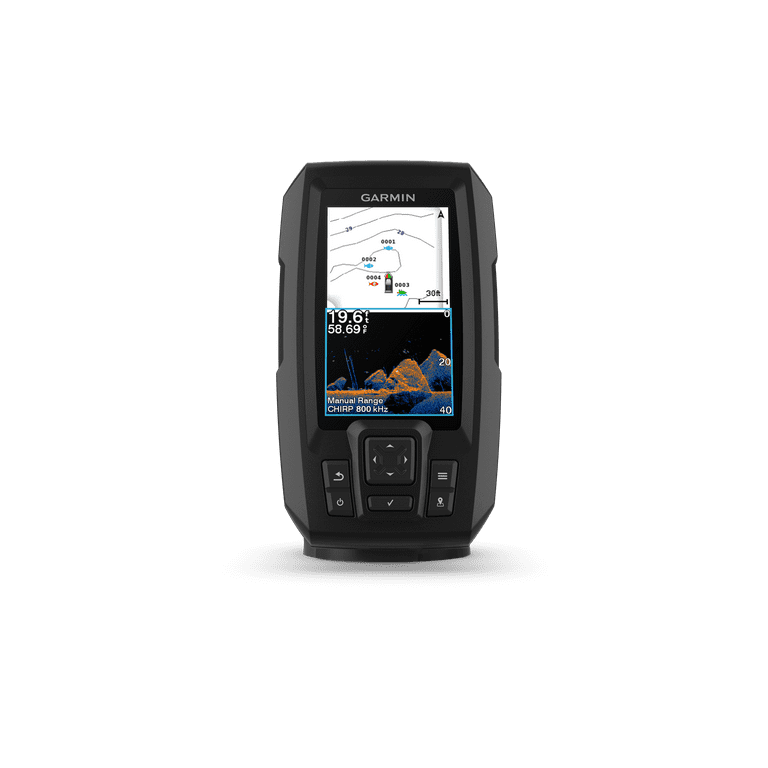
Although it consumes more power than the basic Striker 4, 0.40 amps is still manageable with a compact lithium battery. The bigger decision concerns the transducer mount. ClearVü works best when the transducer has a clean, unobstructed path into the water. An external arm, manufacturer-designed recess, or compatible scupper mount is generally a better choice than shooting through the hull when imaging detail is the reason for buying the unit.
What customer reviews say
Canadian Tire showed a 4.2 average from 27 reviews, with 91 percent of responding reviewers recommending the unit when this guide was researched. Owners commonly praise the value, compact size, screen clarity, GPS, contour recording, and modest battery use. Less-positive reviews mention the learning curve, brightness controls, the lack of an included protective cover, and the limits of a small display. The review pattern supports the Vivid 4cv as a capable compact unit, not as a substitute for a large premium chartplotter.
Customer-review references: Canadian Tire Striker Vivid 4cv reviews and Scheels Striker Vivid 4cv reviews
Why it suits a small kayak
- compact 4.3-inch screen;
- traditional CHIRP plus ClearVü;
- GPS waypoint marking;
- Quickdraw Contours for creating personal depth maps;
- moderate published power draw.
Limitations
- more electrical demand than the Striker 4;
- ClearVü adds mounting considerations;
- no SideVü;
- greater cost and complexity than a basic depth finder.
Who should buy it
Choose the Striker Vivid 4cv if you fish structure, vegetation edges, submerged timber, or unfamiliar water and want a clearer picture of what is directly beneath the kayak. The basic Striker 4 remains the better choice when low power and simplicity come first.
Manufacturer information: Garmin Striker Vivid 4cv
4. Lowrance Eagle 4x — Best simple display for bright conditions
The Lowrance Eagle 4x is designed for kayaks and small boats where space is limited. It uses a four-inch IPS display, autotuning sonar, and the Bullet Skimmer transducer. Lowrance also emphasizes the screen's visibility from different angles and while wearing polarized sunglasses.
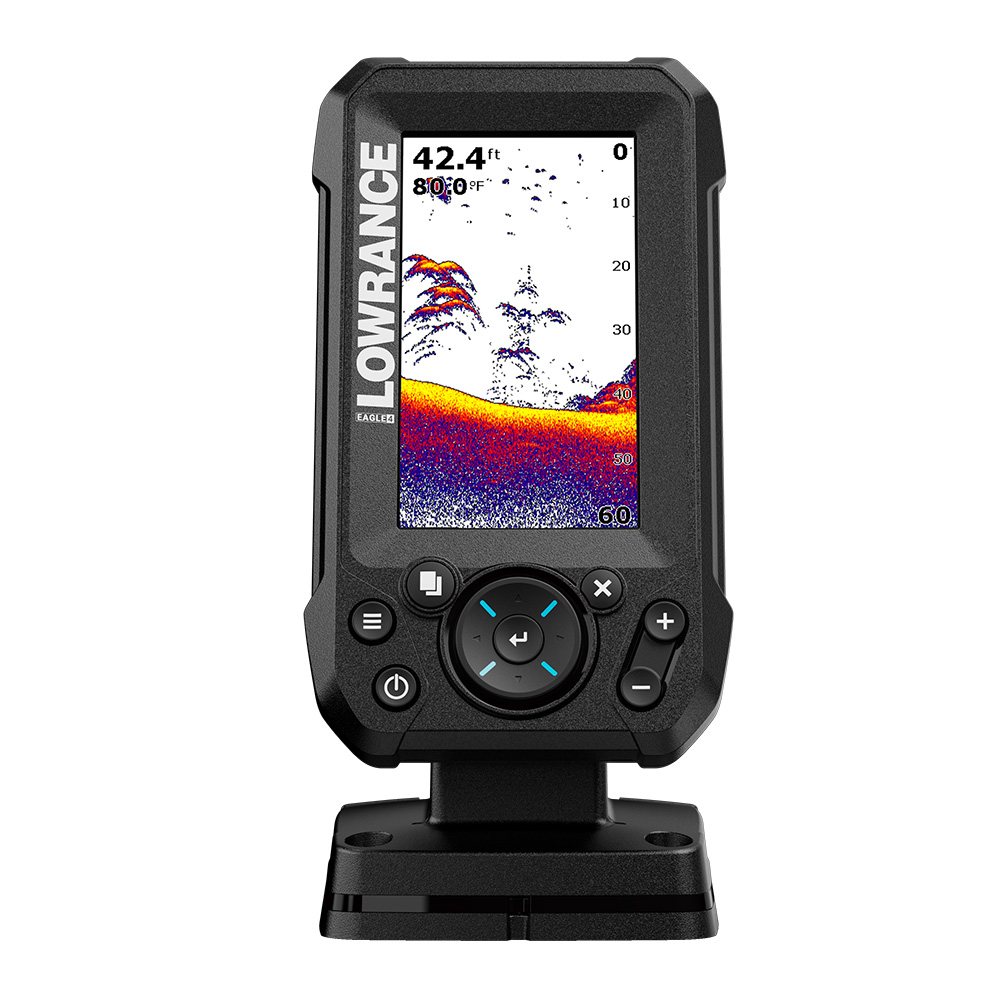
The Eagle 4x should not be confused with the larger Eagle models. Lowrance's own comparison information excludes the 4x from CHIRP, DownScan, SideScan, FishReveal, and mapping features offered elsewhere in the range. Its appeal is simplicity: compact screen, wide-angle conventional sonar, and automatic adjustment.
What customer reviews say
The review sample is smaller than for the Garmin models. Walmart showed approximately 4.2 from 11 reviews on one listing and 16 reviews on another during research. Positive feedback centers on value, a clear screen, easy setup, and dependable depth information. Because the sample is small and some reviews were incentivized, the score should not carry too much weight. Isolated owner reports also mention connector or cable problems. We therefore view the Eagle 4x as a simple budget option, not a proven upgrade over the Striker 4.
Customer-review references: Walmart Lowrance Eagle 4x reviews and Dick's Sporting Goods Eagle 4x review
Why it suits a small kayak
- compact portrait-style display;
- IPS screen intended for outdoor visibility;
- autotuning reduces menu adjustments;
- wide-angle Bullet sonar;
- twist-lock connector makes removal easier.
Limitations
- no GPS or mapping;
- no DownScan or SideScan;
- less detailed feature set than the Striker Vivid 4cv;
- verify the current manual and package contents before calculating battery size.
Who should buy it
Choose the Eagle 4x if you want a straightforward dedicated screen and do not need maps or advanced imaging. It is particularly appealing when polarized-sunglasses visibility and simple controls matter more than feature count.
Manufacturer information: Lowrance Eagle range
5. Garmin Striker Cast GPS — Best fish finder for a rental kayak without drilling
The Garmin Striker Cast GPS removes the external battery, display mount, transducer cable, and permanent installation. The floating sonar connects to a phone or tablet and includes GPS for recording Quickdraw Contours maps.
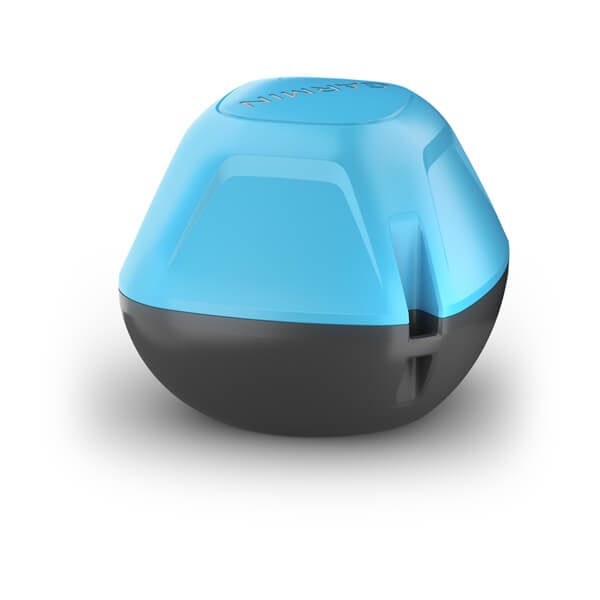
Garmin publishes a typical battery life of 10 hours, a wireless range of up to 200 feet, and a sonar depth range from less than two feet to 150 feet. Water conditions can reduce wireless range, and the unit depends on the phone being charged, visible, and protected.
This is one of the cleanest answers to the question, “What is the best fish finder for a rental kayak without drilling?” It can also work for inflatable kayaks, folding kayaks, and anglers who switch between several small watercraft.
What customer reviews say
One retailer displayed a 4.5 average from 39 reviews when checked. Positive reviews repeatedly describe the unit as easy to pair, portable, and useful for depth, temperature, bank fishing, and ice fishing. The most consistent complaints involve shorter-than-advertised real-world connection distance, intermittent phone connections, app crashes, jumpy GPS, and fish symbols that users do not always trust. The honest conclusion is that it is convenient, but a fixed wired sonar is more predictable when you fish from the same kayak every week.
Customer-review references: STRIKER Cast customer reviews and Best Buy STRIKER Cast reviews
Why it suits a small or temporary kayak
- no external 12-volt battery;
- no holes or permanent mount;
- built-in GPS and personal contour mapping;
- compact and easy to transfer;
- automatically powers on in the water and off when removed.
Limitations
- relies on a phone for the display;
- phone battery and sunlight visibility become part of the system;
- wireless performance can vary with conditions;
- not as tidy as a fixed transducer when paddling continuously;
- use a secure tether and follow Garmin's line-strength guidance.
Who should buy it
Choose the Striker Cast GPS if you rent kayaks, travel with an inflatable, or do not want permanent electronics. A fixed Striker 4 is more convenient for frequent use on one kayak, but the Cast is far easier to move.
Manufacturer information: Garmin Striker Cast GPS
6. Deeper PRO+ 2 — Best castable sonar for detailed mapping
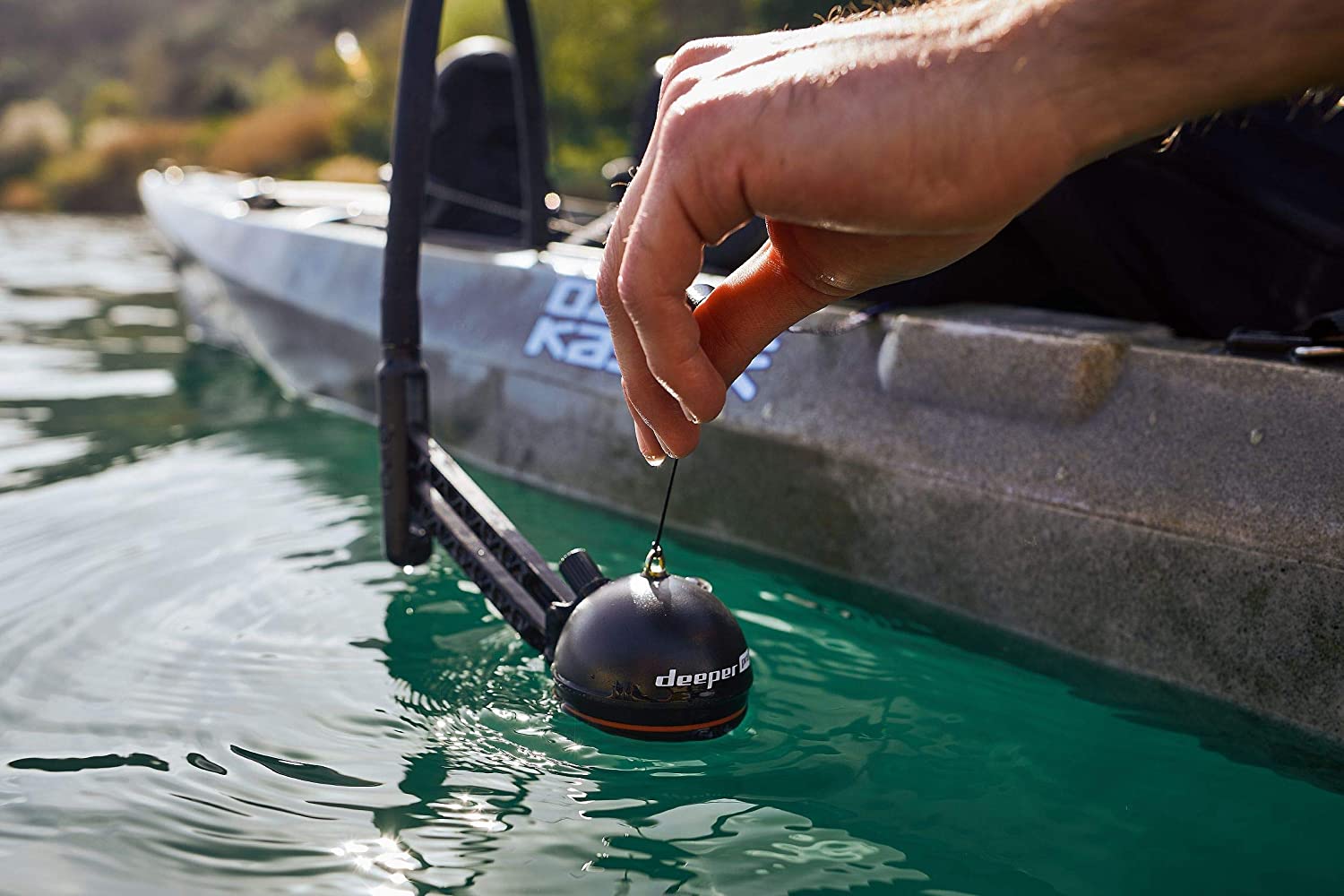
The Deeper PRO+ 2 is another strong option for an inflatable fishing kayak without a permanent mount. It connects directly to a phone through its own Wi-Fi signal, so cellular service is not required on the water.
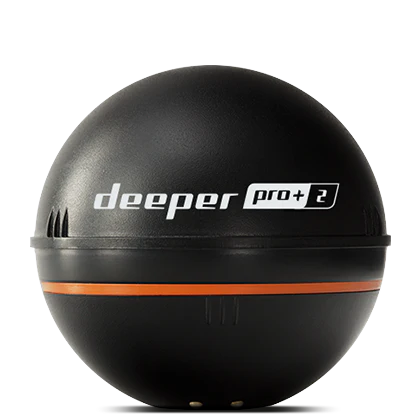
Deeper publishes three sonar frequencies, a scanning depth of up to 100 meters, a connection range of up to 100 meters, built-in GPS, and operating time of up to nine hours depending on use. Its three beam choices provide more flexibility than a basic castable sonar: a wide beam for searching, a medium beam for general use, and a narrow beam for examining a specific target or feature.
What customer reviews say
Owners frequently praise the mapping, clean app display, fast setup, and the ability to use one unit from shore, ice, or an inflatable kayak. Complaints repeatedly involve phone-battery drain, glare, disconnects, charging failures, subscription confusion, and unreliable connectivity when the sonar is submerged by current or kayak movement. Some kayak anglers ultimately prefer a traditional wired finder because it removes the phone and wireless link from the system. The PRO+ 2 makes the most sense when portability and mapping across several fishing styles matter more than uninterrupted fixed-screen operation.
Customer-review references: Deeper customer reviews and kayak-owner discussion of the Deeper PRO+ 2
Why it suits a portable setup
- no permanent display or transducer installation;
- built-in GPS and bathymetric mapping;
- three beam angles;
- usable from a kayak, shore, dock, or ice hole;
- no cellular-data connection required.
Limitations
- depends on a smartphone;
- shorter published runtime than the Garmin Striker Cast GPS;
- Wi-Fi range depends on conditions and phone placement;
- a fixed arm or safe towing arrangement is more convenient than repeatedly casting while paddling;
- availability can vary by market.
Who should buy it
Choose the PRO+ 2 if mapping detail and multiple beam angles matter more than having a dedicated display. It is a versatile choice for anglers who divide their time between kayak and bank fishing.
Manufacturer information: Deeper PRO+ 2
Garmin Striker 4 battery runtime with 7Ah, 10Ah, and 20Ah batteries
Battery runtime is one of the most useful comparisons for a kayak owner, but it is often presented without showing the calculation.
Garmin lists the Striker 4's typical current draw as 0.23 amps. A simple planning formula is:
Estimated runtime = usable battery capacity in amp-hours ÷ average current draw in amps
The table below reserves 20 percent of the battery's rated capacity rather than planning to use every advertised amp-hour.
| 12V battery | Capacity used for planning | Striker 4 estimate at 0.23A |
|---|---|---|
| 7Ah | 5.6Ah | about 24 hours |
| 10Ah | 8Ah | about 35 hours |
| 20Ah | 16Ah | about 70 hours |
These are mathematical estimates, not guaranteed field runtimes. Screen settings, temperature, battery age, wiring loss, battery chemistry, connected accessories, and the difference between typical and maximum draw can all change the result. A battery should also include a suitable fuse, protected terminals, and a charger matched to its chemistry.
For comparison, the same planning method gives approximately 20 hours for a Striker Vivid 4cv on a 10Ah battery at its published 0.40A typical draw. The PiranhaMAX 4's published 0.18A draw produces a longer theoretical estimate, but the absence of GPS is part of that tradeoff.
Garmin Striker 4 vs Lowrance Eagle 4x for a kayak
Both are compact entry-level fish finders, but they suit different anglers.
| Feature | Garmin Striker 4 | Lowrance Eagle 4x |
|---|---|---|
| Display | 3.5-inch color | 4-inch IPS |
| Sonar | Traditional CHIRP | Wide-angle Bullet sonar with autotuning |
| GPS | Yes, waypoint marking | No |
| Mapping | No full charting on basic model | No |
| Published power figure | 0.23A typical | Verify current product manual |
| Best reason to choose it | GPS plus low power | Larger, highly visible simple display |
The Garmin Striker 4 is the stronger all-around choice for most kayak anglers because GPS waypoints are valuable on unfamiliar water and the published current draw is low. The Lowrance Eagle 4x is attractive for anglers who want a larger IPS screen and automatic sonar adjustment without paying for navigation features.
If you need structure imaging rather than basic sonar, neither comparison should end the search. The Garmin Striker Vivid 4cv or a larger Lowrance Eagle configuration with DownScan may be a better fit.
Garmin Striker 4 in-hull mount vs transducer arm
There is no single mounting method that is best for every kayak. The right answer depends on the hull, transducer, water type, and whether the electronics must be removable.
In-hull mount
An in-hull mount places the transducer against the inside of a compatible solid polyethylene or fiberglass hull. Garmin recommends testing the location on the water before permanently installing the mount.
Advantages
- no transducer hanging below the kayak;
- no drag or weed collection;
- protected during launching and landing;
- no need to drill below the waterline.
Tradeoffs
- the sonar signal must pass through the hull;
- accurate water-temperature readings may be lost or delayed;
- not suitable for every hull construction;
- advanced side-looking imaging needs a clear external view.
External transducer arm
A track-mounted arm places the transducer directly in the water and can often be installed on an existing accessory rail.
Advantages
- clean sonar path;
- accurate water temperature;
- removable and adjustable;
- better suited to ClearVü and other imaging transducers.
Tradeoffs
- adds some drag;
- can collect weeds or fishing line;
- must be raised around rocks, ramps, and very shallow water;
- occupies valuable track space beside the seat.
For the basic Striker 4, an in-hull mount can be a clean solution on a compatible polyethylene kayak. For the Striker Vivid 4cv, an external mount is usually more sensible when ClearVü performance is the reason for upgrading.
Official mounting guidance: Mounting a Garmin transducer on a kayak
How to reduce kayak fish finder interference from a trolling motor
Electrical noise can appear as lines, clutter, or an unstable image when the trolling motor runs. Start with the safest, simplest checks:
- Power the fish finder from a separate battery or a dedicated, properly fused circuit.
- Keep sonar and power cables away from trolling-motor wiring where possible.
- Do not coil excess transducer cable tightly around motor-power cables.
- Inspect connectors for moisture, corrosion, or loose terminals.
- Test the fish finder with the motor completely disconnected. If the display becomes clean, the motor circuit is the likely noise source.
- Follow the fish finder and trolling-motor manufacturers' grounding and wiring instructions before adding filters or modifying either system.
A separate small sonar battery is often simpler on a kayak than diagnosing noise on a shared high-current circuit. Do not improvise grounds or bypass fuses; incorrect marine wiring can damage equipment and create a fire risk.
Garmin Striker 4 settings for shallow-water kayak fishing
Shallow water can fill a sonar screen with bottom clutter, vegetation, paddle turbulence, and overlapping returns. Start with conservative settings rather than maximizing sensitivity.
- Begin with automatic gain, then reduce gain if the screen is covered in noise.
- Set the depth range manually just below the actual bottom when automatic range jumps excessively.
- Use the higher-frequency or narrower-beam option when you want better target separation directly below the kayak.
- Slow the scroll speed when the kayak is barely moving.
- Keep the transducer level and below turbulent water.
- Raise an external transducer arm before crossing weeds, rocks, or water that is too shallow for safe clearance.
- Confirm depth with caution near hazards; a recreational fish finder is not a substitute for safe navigation.
Settings should change with water depth, bottom hardness, vegetation, and paddling speed. Save a clean baseline before experimenting with alarms and fish symbols.
What size fish finder is best for a small kayak?
A three- to five-inch display is the practical range for most compact fishing kayaks. Larger screens are easier to read but require more mounting room, more power, and a stronger bracket. Measure the cockpit with the seat, paddle, pedal drive, rod holders, and landing net in their normal positions before choosing a display.
Mount the screen close enough to reach without leaning dangerously to one side. A smaller display positioned correctly is more useful than a larger screen that blocks the paddle stroke or forces the angler off balance.
Buying guide: what matters more than the product name
Power draw
Compare typical current, not only maximum current. Then calculate the battery with a reserve rather than assuming every rated amp-hour will be available.
Screen visibility
A kayak screen sits low and often faces direct sunlight. Physical buttons, adjustable angle, and visibility through polarized glasses can matter more than extra menu features.
GPS and mapping
GPS waypoints help an angler return to a launch, hazard, drop-off, or productive piece of structure. Full mapping is useful on unfamiliar water, but it is not necessary for everyone.
Transducer compatibility
Check the kayak manufacturer's transducer recess, scupper dimensions, and accessory tracks. Do not assume a universal bracket will fit every hull or transducer.
Removal and transport
Car-topping and trailering expose electronics to vibration and damage. A quick-release display and removable arm make storage easier. Castable sonar is even simpler for renters and travelers.
Phone dependence
Castable sonar saves space but transfers the display burden to a phone. Plan for waterproof protection, glare, a secure mount, and enough phone battery for both sonar and emergencies.
Frequently asked questions
Can I use a fish finder on an inflatable kayak?
Yes. A castable unit such as the Garmin Striker Cast GPS or Deeper PRO+ 2 avoids drilling and permanent wiring. Some inflatable kayaks also accept manufacturer-approved accessory bases or removable arms. Do not glue or drill a mount unless the kayak manufacturer approves the method.
Is a 7Ah battery enough for a Garmin Striker 4?
For a normal day, it should provide a large planning margin when healthy and correctly charged. Using Garmin's published 0.23A typical draw and reserving 20 percent of a 7Ah battery produces a mathematical estimate of about 24 hours. Real runtime can be lower, so test the complete system before relying on it for a long trip.
Should a fish finder and trolling motor use separate batteries?
Separate batteries are often the simplest arrangement on a kayak. They isolate the sonar from a motor's high-current circuit and help reduce electrical noise. A shared system can work when engineered and fused correctly, but it should follow both manufacturers' wiring requirements.
Can I install a kayak fish finder without drilling?
Yes. Options include a compatible in-hull mount, an existing gear-track arm, a scupper mount designed for the kayak, a suction mount for limited use, or a castable sonar. Test fit and signal quality before committing to adhesive or permanent changes.
Is a four-inch fish finder big enough for kayak fishing?
Yes, especially when it is mounted within easy reach and used for a single sonar view. A larger screen becomes more helpful for split-screen mapping, SideScan, or live sonar, but it also takes more power and deck space.
Do I need GPS on a kayak fish finder?
GPS is not essential on a familiar pond, but waypoint marking is useful for returning to structure and identifying the launch in low visibility. Anglers who already use a waterproof phone or handheld GPS may prefer a simpler sonar-only display.
Final verdict
The Garmin Striker 4 is the best low-power fish finder for most small kayaks because it balances traditional CHIRP sonar, GPS waypoints, physical controls, and a published 0.23A typical current draw.
Choose the Humminbird PiranhaMAX 4 when the lowest published power draw matters more than GPS. Upgrade to the Garmin Striker Vivid 4cv when structure detail and personal contour mapping justify a slightly larger battery and a more careful transducer installation. The Lowrance Eagle 4x is the straightforward alternative for a bright, simple dedicated screen.
For rental, folding, or inflatable kayaks, skip permanent installation and choose between the Garmin Striker Cast GPS and Deeper PRO+ 2. The Garmin offers longer published typical battery life, while the Deeper provides three beam frequencies and greater published depth and connection range.
Whichever model you choose, plan the entire system—not just the display. Battery, fuse, cable route, transducer placement, screen position, and removal method determine whether the fish finder helps on the water or becomes another piece of gear fighting for space.